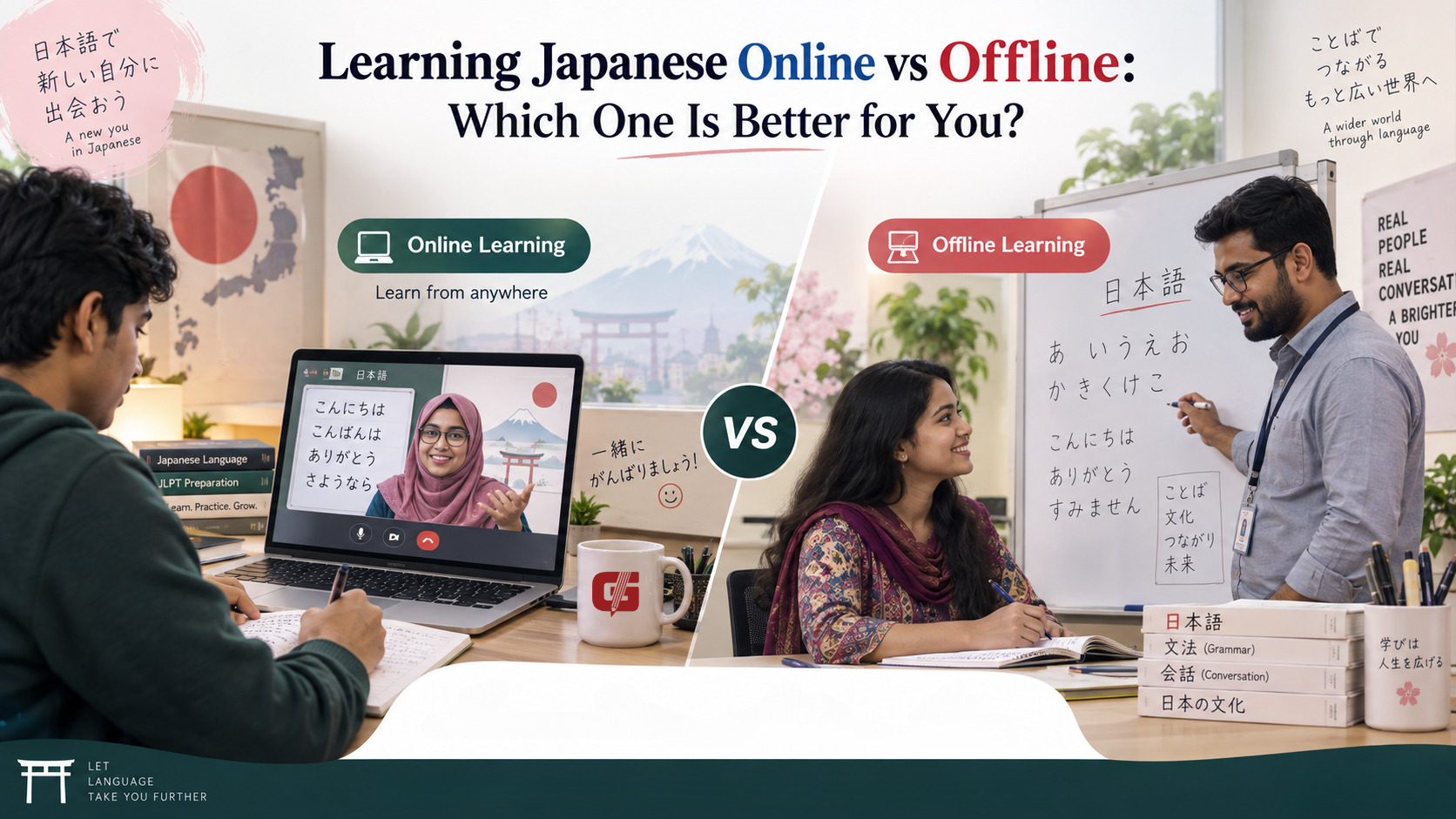
If you are planning to learn Japanese for study, work, or future opportunities in Japan, one of the first decisions you may face is how to learn the language.
Should you join an offline Japanese language course, study online, or combine both methods?
There is no single answer for every student. The right choice depends on your learning style, schedule, budget, current Japanese level, and long-term goal.
At Global Academy Bangladesh (GAB), we believe students should choose a learning method based on their individual needs rather than simply following what is popular.
Why Is the Learning Method Important?
Japanese is different from English and Bengali in several ways. Students need to learn:
- Hiragana
- Katakana
- Kanji
- Vocabulary
- Grammar
- Pronunciation
- Listening
- Speaking
- Reading
- Writing
Learning Japanese therefore requires regular practice and interaction.
A course can provide the structure, but students also need independent practice outside class.
Learning Japanese Offline
Offline learning means attending physical classes where students and teachers interact face-to-face.
Advantages of Offline Japanese Classes
One of the biggest advantages is direct interaction with the teacher.
When students make mistakes in pronunciation, grammar, or sentence formation, the teacher can identify the problem and provide immediate feedback.
Offline classes can also provide:
1. A Structured Learning Environment
Students have a fixed class schedule and a specific place for learning. This can help learners maintain consistency.
2. More Speaking Practice
Students can practice Japanese directly with teachers and classmates. This is particularly useful for developing confidence in conversation.
3. Immediate Feedback
If a student has difficulty with pronunciation, Kanji, grammar, or sentence structure, they can ask questions immediately.
4. Better Classroom Interaction
Learning alongside other students creates opportunities for pair work, group activities, role-play, and conversation practice.
5. Accountability
For students who find it difficult to study independently, attending regular classes can provide additional motivation to continue learning.
For many beginners, having a teacher physically present can make the early stages of Japanese learning easier to manage.
Learning Japanese Online
Online Japanese courses allow students to learn from home or another convenient location using a computer, tablet, or smartphone.
Advantages of Online Japanese Classes
1. Flexibility
Students can attend classes without travelling to a physical classroom. This can be useful for students who live far from a language institute or have busy schedules.
2. Convenient Learning Environment
Students can study from home or another suitable location.
3. Access to Digital Resources
Online learning can easily incorporate digital materials such as videos, audio recordings, online dictionaries, flashcards, and interactive exercises.
4. Suitable for Busy Students
Students who are balancing university, work, or other responsibilities may find online classes more convenient.
However, online learning also requires self-discipline. Simply attending an online class does not guarantee language proficiency.